

This book is a transcreation of the famous, ancient Dao De Jing (a.k.a. Tao Te Ching) which hopes to bring new vitality to the text in two main ways.
First, a lengthy Introduction offers a theoretical and critical frame for the text in which the Dao is re-introduced as a ‘way of subversion,’ where the aim of the famous paradoxes and passages of the book is to re-direct thought and attention not toward a Supreme or Omnipotent Dao but toward creative and spontaneous gestures and paths not taken. Here, I compare and contrast Daoist thought with contemporary ‘Western’ critical theory and philosophy, including the work of Jacques Derrida and Richard Rorty, as I explore key areas of thought discussed in the Dao De Jing, including the power of naming, active non-action, and yin/yang.
Second, the translation, itself, takes liberties with the text and follows a style far less parsimonious than all extant English translations of which I am aware. The intention in doing so is to use new or alternative literary devices (repetition, alliteration, free association, spontaneous exposition, and more) to elucidate the unique and complex messages of the book’s chapters in the spirit of the Dao as I understand it.
I call the book a “transcreation” because it is not a direct translation from the classical Chinese (which I cannot read). Like other translations that rely on English (and French) translations, such as Ursula Le Guin’s or Stephen Mithcell’s, mine is a “poetic translation” that has been complied through extensive research and comparison of scores of existing translations and commentaries on both the Dao De Jing and the Zhuangzi.
Readers of my transcreation of the Dao De Jing will find a completely fresh outlook on the text and, hopefully, a renewed interest and passion for its richness and generativity.

M.H. Bowker’s Walls is a contemplative essay that is sometimes playful and sometimes grave. At first blush, its subject matter would appear simple. Walls considers (1) the psychic meaning of walls and (2) the meaning of psychic walls.
It turns out that these two subjects are intimately and interestingly related, such that meditating on one turns out to be fruitful in terms of our understanding of the other. Bowker treats walls literally and metaphorically, from the ‘wall’ between nature and civilization, to Kafka’s musings on the Great Wall of China, the to the walling off of a person’s interior world. There is even a place for Humpty Dumpty.
In each of its short chapters, Walls has been written with an intention of inclusivity. That is, no advanced prior knowledge or jargon-thought should be necessary for the reader to appreciate what may be found herein. This of course, implies that, very often, the reader and the author find themselves beginning from first principles, which is always far more difficult than people seem to believe.
Go to book page for more info., summary, and links
As If / Als Ob is not a book that offers simple conclusions. It is a book that stages a struggle: the struggle to remain a subject in a world that no longer provides reliable grounds for meaning, coherence, or moral certainty. Written in a hybrid form that moves between lyric meditation, philosophical analysis, psychoanalytic reflection, and autobiographical fragment, the book asks a deceptively simple question: What does it mean to live “as if” one were real, responsible, and grounded, when these grounds, themselves, are missing or broken?
The work begins from an intimate premise. Thought, feeling, and language are experienced not as stable possessions but as precarious “births”: seemings and beings that emerge through effort, pain, and uncertainty. Reality is not given but must be produced again and again. Bowker describes subjectivity as something that must be continuously assembled from resonance, memory, and symbolic improvisation. What feels real is what vibrates inwardly. What counts as real socially is what is authorized by institutions, norms, and collective agreement. Between these two forms of reality, the modern subject must learn to survive.
From this starting point, As If develops an extended meditation on seeming and being, not as opposites, but as intertwined modalities of existence. Sometimes seeming protects being. Sometimes it replaces it. Sometimes it becomes the only available form of survival. Drawing on the psychoanalytic work of Winnicott, Laing, Deutsch, and Freud, the book shows how false selves, adaptive performances, and “as if” personalities arise not from deceit, but from necessity. They are emergency structures erected when authentic being is impossible.
Bowker interweaves clinical narratives, literary analysis, and philosophical interpretation to illuminate this fragile architecture of selfhood. We encounter patients who speak only in quotations, who inhabit horror films as psychic habitats, who survive through mimicry and simulation. We encounter figures—Kafka’s Georg Bendemann, Camus’ Jan, Levi’s Sonderkommando—whose lives unfold in ethical grey zones where ordinary judgment fails. These figures are not presented as case studies in pathology, but as witnesses to damaged forms of subjectivity that reveal something fundamental about modern life.
At the philosophical center of the book stands Immanuel Kant’s Critique of Judgment, and in particular Kant’s notion of reflective judgment: the capacity to orient oneself in the absence of rules. Bowker reads Kant alongside Primo Levi’s account of the “grey zone” of the concentration camps, arguing that both thinkers confront the same problem from different angles: how judgment must continue even when its foundations have collapsed. We must judge as if coherence were possible. We must act as if responsibility still matters. We must live as if dignity has not been extinguished, even or especially when history, institutions, and trauma suggest otherwise.
This “as if” is not a comforting fiction. It is a necessary illusion. Without it, experience fragments into chaos or submission. With it, subjectivity becomes possible, though always at risk. The book shows how this fragile structure can be used to preserve life or to destroy it. Kafka’s The Judgment becomes, in Bowker’s reading, a parable of how authority colonizes conscience. Judgment ceases to orient and begins to annihilate. The subject internalizes an external verdict and executes it upon himself.
Throughout, As If refuses academic detachment. The author’s own life appears briefly: not as confession, but as evidence. Memories of fear, madness, guilt, institutional violence, and maternal condemnation are woven into the argument. The voice that speaks is not that of an external observer, but of someone who has lived inside the structures being analyzed. The book is as much a record of survival as it is a theory of it.
Stylistically, the work resists genre. It moves from poetic incantation to rigorous exposition, from anecdote to abstraction, from humor to grief. It performs its argument formally: coherence emerges and dissolves, metaphors recur and mutate, philosophical concepts are refracted through lived experience. Reading As If is intended to feel less like receiving information than like inhabiting a mind in motion.
The concluding section returns to Helene Deutsch’s concept of the “as if” personality, showing how contemporary subjectivity is increasingly organized around performance without depth, fluency without attachment, coherence without foundation. The modern subject learns to appear human before learning to feel human. Social legibility replaces inner resonance. Simulation becomes identity. Yet Bowker does not simply condemn this condition. He shows how it arises from historical necessity and psychic injury. He asks whether illusion, carefully held, may still preserve something real.
Ultimately, As If / Als Ob is a book about how human beings continue to exist under conditions that should make existence impossible. It is about judgment without guarantees, morality without purity, identity without essence, and meaning without metaphysics. It is about the labor of appearing human when humanity has been structurally damaged.
This is a book for readers who are dissatisfied with both academic philosophy and popular self-help, who suspect that neither captures the depth of contemporary psychic life. It is for those interested in psychoanalysis, continental philosophy, literature, trauma studies, and radical ethics—but also for anyone who has ever felt that their reality depended on holding together something fragile and unprovable.
Go to book page for more info., summary, and links
Lawn Pig: A Critique of Nothingness is not a book about “nothingness” in the familiar philosophical sense. It is an excavation of a mistake—one that philosophy, theology, psychoanalysis, and political theory have repeated for centuries: the substitution of nothingness for loss.
Across nine tightly composed yet formally volatile movements or “Parts,” M.H. Bowker dismantles the consolations of abstraction. “Nothingness,” here, is revealed not as an ontological ground or metaphysical mystery but as a defensive construction—an anesthetic that allows us to avoid the psychic reality of deprivation, abandonment, environmental failure, and the disappearance of bodies that should have been there. What philosophy often elevates into structure or lack, this book drags back into experience.
Written in a hybrid form that fuses philosophical argument, psychoanalytic theory, musical notation, liturgical cadence, and dream narrative, Lawn Pig refuses the safety of genre. Its prose moves between disciplined conceptual critique and moments of lyrical, sometimes brutal, exposure. Winnicott, Lacan, Heidegger, Hegel, Hobbes, Ecclesiastes, Job, Beckett, Kafka, Stevens, Cage, and Freud are not cited to be honored but interrogated—tested against the lived fact of loss rather than allowed to float at the level of theory.
At the book’s conceptual core is a sharp distinction: privation and lack are not the same as deprivation and loss. Nothingness belongs to language; nothing belongs to experience. And nothing, when it occurs, is catastrophic—not empty, not peaceful, not generative, but shattering. The infant without a body. The subject without a holding environment. The adult still haunted by the residue of that disappearance.
The figure of the “lawn pig”—absurd, obscene, useless, stubbornly present—functions as both emblem and irritant: a reminder that nothing does not behave like silence. It squeals. It repeats. It produces sound. The book’s most disturbing section, a recurring dream narrative of inescapable violence and failed authority, makes explicit what the theory insists upon: nothing is not an idea we contemplate, but a condition we survive, again and again, by irrational means.
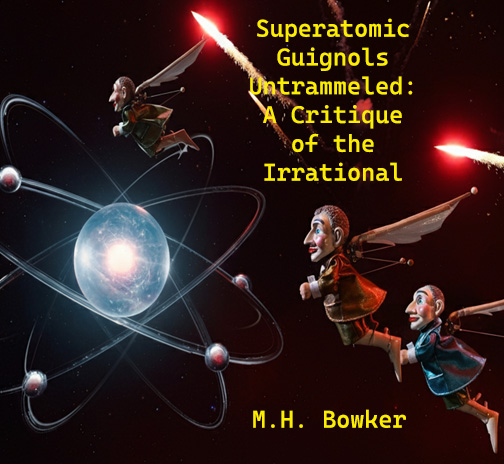
“Lawn Pig” is the second volume in a duo (see: “Superatomic Guignols Untrammeled: A Critique of the Irrational”) that seeks not to destroy philosophy or psychoanalysis but to return them to psychic reality—to responsibility, to memory, to the body, to what should have been there and was not. It will resonate deeply with readers of continental philosophy, psychoanalysis, experimental nonfiction, trauma theory, and radical literary form—especially those who suspect that something vital has been lost beneath the elegance of abstraction.
This is a book that does not soothe. It does not resolve. It insists. And once read, it is difficult to return to the idea of “nothingness” without hearing, somewhere underneath, the sound it was meant to silence.
Go to book page for more info., summary, and links
Génopsenseur: Genius / Censor / Psychopath is a radical hybrid text and uncompromising experimental work that treats thinking not as a stable activity but as a complex and volatile event: something that happens, collapses, reforms, and often destroys itself in the process. Written as a sustained monologue punctuated by pauses, reversals, stage directions, theoretical digressions, lyric eruptions, and analytic demonstrations, the book places the reader inside a mind attempting, again and again, to locate itself in a world that no longer holds still.
The text opens not with exposition but with disorientation: a speaker who does not know where he is, who must identify objects to reassure himself of reality, who wonders whether “world-feeling” itself has been lost. Rooms appear and dissolve. Places recur as memory-traces rather than coordinates. Environments are not containers but extensions of psychic life—“noplace environments” carried with the subject rather than inhabited. Throughout, the book stages consciousness as something always mid-formation, never finished, never secure.
Génopsenseur stages thought itself as a scene of instability. Written as a sustained monologue punctuated by interruptions, restarts, and stage directions, the book explores subjectivity as a precarious achievement: one that must be continually reconstructed in the face of internal censorship and psychic violence.
At the core of the work is its tripartite figure: genius / censor / psychopath. Not three distinct characters, but rather three inseparable functions of the same mind generate the work. Creativity produces insight, but censorship represses it; psychopathology emerges from the manifold contradictions between the two. Repression is treated not metaphorically but logically, exposing the paradox of a censor that must simultaneously (and impossibly) know and not know what it forbids.
Reading Génopsenseur feels at times like inhabiting consciousness mid-formation. The voice veers between lyric intensity and analytic rigor, between philosophical argument and disoriented perception. Moments of lucidity give way to drift; clarity produces its own collapse. The book’s preoccupations are “home,” displacement, “world-feeling,” and being seen by others.
Formally spare yet conceptually dense, Génopsenseur is more of a glimpse into a mental climate than a story or play. It is comical, intellectually ferocious, and emotionally open/exposed. It is a work for readers drawn to philosophy that risks breaking down in order to tell the truth.”
What follows from this formulation is not a theory offered from above, but a theory enacted. The book’s most sustained analytic section takes up the foundational psychoanalytic concept of repression and subjects it to relentless logical pressure. Freud’s metaphor of censorship is shown to harbor a contradiction: any censor must both know and not know the material it forbids, a paradox that generates infinite regress when modeled as an inner agent. Rather than resolving this through new structures or hypostatized psychic entities, Génopsenseur proposes a radically different orientation—an evental understanding of mind in which subjectivity, agency, repression, and creativity are not things but momentary achievements produced by converging series of events.
This evental ontology is not presented as abstraction alone. It is lived in the prose. Genius appears as moments of extraordinary associative capacity, where categories dissolve and meanings collide. The censor emerges as sudden cuts, redactions, shifts in tone, analytic intrusions, and self-sabotaging clarifications.
Psychopathology surfaces not as spectacle but as necessity: the price of knowing too much, too fast, too fluidly, without the stabilizing comforts of shared structures. Each function arises, does its work, and vanishes, only to be recreated moments later under slightly altered conditions.
Stylistically, the book moves with remarkable range. Lyric passages describing rooms, weather, memory, and drift give way to dense philosophical argument; footnotes coexist with jokes, insults, and sudden tenderness. The voice may sound omniscient one moment, then lost, embarrassed, or furious the next. References to Wallace Stevens, Sartre, Camus, Freud, Whitehead, Lacan, and others are not remembered reverently but tested, dismantled, and reassembled in real time. Thought here is not cumulative but recursive, circling back through its own failures with increasing urgency.
Despite its rigor, Génopsenseur is often darkly funny. The intelligence on display is sharp enough to turn against itself, exposing vanity, shame, and the absurdity of intellectual posturing. Yet the book is also deeply intimate. Beneath the theoretical scaffolding lies a persistent concern with attachment, recognition, exile, and the terror of not being held in mind by others. The question of “home”—psychic, linguistic, relational—haunts every page.
Génopsenseur is not a book that explains itself cleanly, nor does it aspire to consensus. It is a work that insists on difficulty as an ethical stance, refusing simplification where simplification would falsify experience. Readers drawn to experimental philosophy, psychoanalysis, avant-garde literature, and works that blur the boundary between thinking and breakdown will find here not an argument to accept, but a climate to enter—one in which consciousness is shown doing what it always does: forming, censoring, fracturing, and trying, against all odds, to speak.
Go to book page for more info., summary, and links
Annotations of a Failure is an experimental, polyphonic work that unfolds as a staged confrontation between the author, his deceased mother, his schizophrenic brother R—, and an entity called the Annotation: a figure that functions simultaneously as footnote, critic, superego, and literary afterlife. Not exactly memoir, nor play, nor philosophical treatise, the book performs failure as a lived condition rather than a result to be overcome.
Structured in eleven acts, the text moves through dialogue, lyric fragments, critical glosses, and dramatic stage directions that are never merely theatrical. Each voice speaks from a different psychic position, and none is granted authority. The mother appears at once intimate and persecutory, tender and annihilating; R— speaks from the unstable brilliance of psychosis, offering insight that is inseparable from danger; the author oscillates between analytic rigor and collapse; Annotation interrupts, reframes, corrects, and exposes, refusing the comfort of narrative continuity. The result is not synthesis but tension sustained over time.
The reading experience is intimate, volatile, and self-interrupting. Language hesitates, revises itself, contradicts itself, and then insists again. Philosophical reflection collides with familial memory; lyrical passages coexist with scholastic commentary; stage directions bleed into confession. The book does not seek to explain anxiety, love, guilt, sin, or dependency from a safe conceptual distance. Instead, it treats them as forces that constitute subjectivity itself—forces that cannot be resolved without falsification.
At the center of the work is a sustained meditation on anxiety and writing: anxiety as the cost of becoming an “I,” writing as both an attempt to survive that cost and an act that inevitably compounds it. Drawing on psychoanalysis, theology, philosophy, and poetry, the book interrogates the fantasy of selfhood, the violence implicit in individuation, and the guilt bound up with asserting one’s own existence in relation to beloved others. Failure, in this sense, is not incompetence or lack of achievement; it is fidelity to experience that cannot be rendered coherent without betrayal.
One of the book’s defining refusals is its rejection of consolatory arcs. There is no recovery narrative, no redemptive closure, no stable vantage point from which the past can be mastered. Thought emerges from fracture rather than resolution; love wounds as much as it sustains; and writing appears as an ethically compromised practice—necessary, obsessive, and never innocent. Even insight is treated with suspicion, as something that risks hardening into false mastery.
Formally, Annotations of a Failure is as much about interruption as it is about speech. The annotative voice undermines the fantasy of transparency; the dramatic structure exposes the theatricality of confession; the oscillation between poetry and analysis resists genre as a means of containment. What remains is not clarity but proximity: to damaged attachment, to inherited guilt, to the unresolvable tensions between self-love and love of others.
This is a book for readers interested in experimental literature, psychoanalysis, philosophy, and hybrid forms that refuse to separate thinking from living. It does not ask to be consumed easily or admired from a distance. It asks instead to be endured, argued with, and inhabited as an annotation not only of failure, but of the conditions under which a self attempts, again and again, to speak the truth. The dialogue moves from the naming of failure and anxiety, through sin, self-division, love (philautia), and familial haunting, toward a final social confrontation with others and the world.
Go to book page for more info., summary, and links
It is difficult to summarize the work undertaken in Superatomic Guignols Untrammeled. It is both a study and a performance of the irrational, combining philosophical inquiry with linguistic hyper-experimentation.
The work immediately abandons traditional syntactic norms, aiming to embody its subject matter, “a critique of the irrational,” through nearly indefinable (yet still comprehensible) gestures at irrational thought.
Although written in a deliberately fragmented and free-associative style, thus resisting conventional ‘outlines’ of thought, it is possible to offer a structural overview of the text, in the spirit of orientation rather than explanation.
- A Beginning and a House
Explores the tension between beginnings as fundamental and beginnings as precarious. - Limits
Considers the boundaries imposed by rational frameworks and the creative ruptures necessary to transcend them. - Further Reflections on Things Related
A meditation on the associative and disjunctive nature of irrational thought, where alignment is arbitrary and meaning emerges impossibly. - Value Choice
Examines the paradox of valuing irrationality, where decisions must arise from unarticulated, subjective impulses rather than systematic reasoning. - Thinkers and Think-errs
Contrasts the imaginative genius of irrational creation with the fallacies of distorted reasoning. - Auto Da-Fé
Confronts the self’s exposure to the “ferocious light” of existence, where identity faces a trial of “sheer reality.” - Objective (Sub- or Pseudo-Rationality) and Subjective (Ir-Rationality)
Distinguishes the subjective, creative potential of irrationality from the stifling missteps of pseudo-rational systems. - Like an Irrational Number, Opera
Considers irrationality as a continuous, undefinable process, likened to the infinite operation of irrational numbers. - Way Out
Proposes feelings as an alternative compass, guiding action and understanding when reason falters or disintegrates. - When a Person
Explores the intersection of irrationality and personhood, where contradictions and incoherence define the essence of being a human person. - Benediction
A reflection emphasizing shared mystery and the ineffable unity within subjective divergence. - Watch Where What
Examines the descent of rational systems into incoherence, using rain as a metaphor for collapsing structures and the innumerable. - To Whom Is It Just
Ponders the relativity of rationality, situating it as a judgment dependent on the observer’s position and context. - After Lisbon
Reflects on historical shocks, like the infamous Lisbon earthquake, as moments where subjective irrationality transforms non-rational devastation into creative agency. - Divinity Was the Way
Traces the historical transition from divine containment of irrationality to its present, surprisingly precarious existence. - No One Knows
Acknowledges the unknowable origins and mechanics of imagination, suggesting shared irrationality as a grounding for human connection. - Our Obsession
Critiques the obsession with rationality as a pursuit of control and the misapprehension of irrationality as liberation. - Of a Self That Is
Explores the porous boundaries of selfhood, where identity is negotiated between individuality and collective belonging. - Of Psychoanalysis We May Say
Positions psychoanalysis as a domain of the irrational, revealing its centrality in understanding the incomprehensible. - A Meager Mundo
Warns of the impoverishment of a world stripped of imagination, emphasizing irrationality as the source of vitality and meaning. - A Cicada is Crying
Concludes with a poetic vision of irrationality’s presence in daily life.
Go to book page for more info., summary, and links
“Matthew H. Bowker’s Critical Thinking and the Subject of Inquiry inspires readers, learners, and teachers to engage with the book’s central thesis that a crisis in critical thinking impedes our personal, social, and political development as subjects with agency. Bowker innovatively reformulates the critical thinking process as one where teachers and learners move from a skills-based method toward a facilitative approach that engages the person’s autonomy as a subject, not a passive object, of our surroundings. The goals of the work are further aided by insightful discussions—spanning the periods of ancient Greece to the mid-and-late twentieth century—of a variety thinkers and their problematics, all of whom provide rich cues for becoming better critical thinkers. In Bowker’s work, readers, learners, and teachers are provided with a rich armamentarium for dynamically continuing their engagement with the psychological, political, and epistemological horizons of our world.”
— Jack Fong, Professor of Sociology, California State Polytechnic University, Pomona
“Matthew H. Bowker’s book on critical thinking is probably the best work written on this deservedly fashionable topic. Unlike so many others, Bowker understands that critical thinking has to have something important to think about. The book’s second part, which covers Plato, Montaigne, Camus, Kafka, and others, illustrates what it means to think critically in a particular intellectual and cultural context. Of special interest is Bowker’s recognition that emotional states matter. Narcissists can’t learn. To learn requires that one first admit one’s ignorance. Authority and the pressures of conformity also impair critical thinking. Not just an introduction to critical thinking, Bowker’s is a tour de force from which the highly educated to the self-educated will benefit.”
— C. Fred Alford, Professor of Government and Distinguished Scholar-Teacher Emeritus,
University of Maryland, College Park
“Critical thinking is a nearly ubiquitous term in education, but the best means of understanding and teaching critical thinking are unclear or elusive. Matthew H. Bowker has given us a psychologically grounded, realistic, and ultimately hopeful portrait of critical thinking as a capacity available to anyone who is willing to undertake the challenge of developing it. Bowker’s book is essential reading for students (both young and old), teachers at all levels, and anyone aspiring to find better ways of living within the challenges of our present moment.”
— David W. McIvor, Ph.D., Professor of Political Science, Colorado State University
Go to book page for more info., summary, and links
“In this honest, probing, and inspiring book, Dr. Matthew H. Bowker sheds light on a life of greater authenticity, bravery, and freedom. The Power of Being a Subject will be of interest to anyone yearning to transform legacies of trauma and suffering, escape from unconscious internal and societal forces and self-defeating patterns, and live a more creative and empathic life.”
— Jeffrey B. Rubin, PhD, Psychoanalyst, American Institute of Psychoanalysis and Object Relations Institute
“This is fascinating study of subjectivity and its relation to one’s self. It is also a powerful and moving account of Bowker’s own struggle with subjectivity and its impact on both his personal and professional life. An intense and scholarly inquiry into this critical idea and what its pursuit means for our day-to-day lives, Bowker’s book is a must read.”
— James M. Glass, PhD, Professor Emeritus, University of Maryland, College Park
“Dr. Bowker’s book is perhaps best described as an intimate ‘travelogue,’ something akin to an innerscape version of Mark Twain’s remote journeys. Weaving ideas with personal reflections, Dr. Bowker takes an honest claim to the title of ‘poet-philosopher’ or ‘philosopher-poet.'”
— Dan Livney, PsyD, Psychologist in private practice
Go to book page for more info., summary, and links
‘A timely, deeply thoughtful collection of psychoanalytically framed accounts of the meaning of the Covid-19 pandemic, and of democracy’s inability to effectively manage it for so many citizens. These well-organized analytic reflections are worth reading over and over again. Thanks to the editors Matthew Bowker and Amy Buzby for exhibiting the under-appreciated explanatory compatibility of psychoanalytic theory and democratic theory for coping with catastrophic events.’
— Michael A. Diamond, PhD, Professor Emeritus of Public Affairs and Organization Studies, University of Missouri, Columbia
‘Matthew Bowker and Amy Buzby assemble a cast of sharp analysts to sift illuminatingly through the wreckage wrought as much by responses to Covid-19 as by the malady itself … Getting Lost is a valuable kickstart to post-mortems on the political consequences of the psychological dimension of the crisis.’
— Kurt Jacobsen, University of Chicago and co-editor of Free Associations
‘The paradoxical nature of the Covid pandemic – creating longing for connection while thwarting it, unleashing the communal terror of an illness that had to be borne alone if we were all to survive – ripples through and shapes the world we live in now. This intriguing book seeks to make sense of its interpsychic, relational, and societal impacts. At a time of “world wrenching stress in public life” when our “individual and shared capacity for holding is collapsing,” these writers offer us a necessary form of containment, an opportunity to grieve for the elusive return to normal, and a reimagining of the challenges of public and private life in the context of that grief.’
— Barbara Wren, Consultant Psychologist, Director of Barbara Wren Psychology, and author of True Tales of Organisational Life
‘For counsellors, psychotherapists and teachers seeing the post-COVID malaise reflected in the behaviour of clients and students, the book is a compelling if unsettling read. Getting Lost provides a valuable framework for counsellors and psychotherapists seeking to understand the lingering impact of the pandemic on our capacity to relate to one another, offering an illuminating but rather pathological account of personal and collective withdrawal in a post-COVID, post-truth world.’
— Therapy Today, John Marsden MBACP (Accred), March 2026, Volume 37, Issue 2

Go to book page for more info., summary, and links
Elements of this book, Oblation: Essays, Parables, Paradoxes, defy reason. They do so for good reason. Much of what we do, much of what we think, is oblation: sacrifice, offering, to something or someone. The root of “oblation” is “to draw near” or “to dwell in.” It refers to what is brought unto the altar, literal or proverbial — the profoundest oblation being what binds us together, our very souls, our dearest loves, indistinguishable from ourselves, our Isaacs on our Mount Moriahs.
The natures of our oblations characterize our relationships to objects great and small, e.g., Lords and loved ones, groups and masses of signifiers. Oblative transactions promise meaning, yet we are full of uncertainty. What is it that cries out for oblation? How do we hear its voice? Are we, in fact, called, or do we, on the contrary, offer every bit gratuit? Why, as Albert Camus famously remarked, do “the stage sets collapse” as we offer ourselves to life’s routine?
In Oblation, M.H. Bowker considers these questions in a series of essays touching upon figures such as Franz Kafka, Edgar Allan Poe, Baron van Münchhausen, and Jacques Lacan, unraveling themes of loss, hatred, and the Munchausen syndrome by proxy. Interspersed with brief parables and paradoxes, Bowker’s essays push us to wonder who or what we are offering ourselves and others to – and how we get away with this.

Go to book page for more info., summary, and links
The Angels Won’t Help You is a powerful series of mediations on the nature of help, the limitations of the idea and concept of care, and the human response to helplessness. Bowker looks at the family as central to our experiences of help; the relation of help to civic responsibility, ideas explored in the context of contemporary literature, Greek myth and tragedy, and a brilliant analysis of Camus’ notion of absurdity, his novels The Fall and The Plague, and psychoanalytic theory. Some of its most striking moments occur when Bowker describes his own time as an in-patient in a mental hospital, and then follows that discussion in the next chapter with a searing account of Kathleen Acker’s Book, Blood and Guts in High School, and Jerzy Kosinski’s Holocaust novel, The Painted Bird. It is difficult to put the volume down; Bowker draws you into some fascinating philosophical puzzles, and explores both the limitations and possibilities of help, the use of psychoanalytic theory to understand it and the intricate and often frustrating dialectic of helplessness, help and care. It is a must read.
— James Glass, author of Jewish Resistance During the Holocaust: Moral Uses of Violence and Will
Go to book page for more info., summary, and links
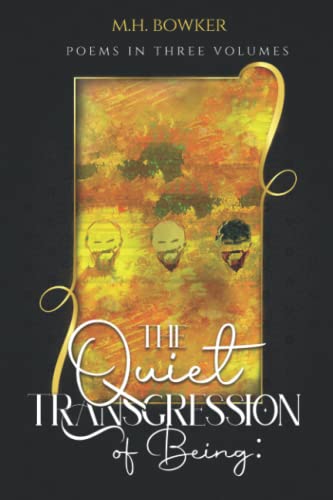
The Quiet Transgression of Being is a three-volume poetic, psychoanalytic, and philosophical exploration of the ideas of anxiety, mystery, and divinity in relation to what Bowker calls ‘acquiescence to the sin of somethingness.’
Go to book page for more info., summary, and links
Key Features & Highlights
- The first English translation of Pierre Delion’s ideas.
- One essay examines the psychiatric establishment, the other considers democracy’s place in society.
- Highlights the broader political connections between the clinical institution and society as a whole.
- What is Institutional Psychotherapy? examines the psychiatric establishment and institution, arguing that for institutional psychotherapy to be effective, we must “care for the institution” just as we must attend to the “transferential constellation” of the patient. And, as Delion duly notes: “What holds for person-to-person psychiatry also holds true for democracy.”
- The Republic of False Selves maintains that our social bonds have been damaged or destroyed to the extent that the practice and meaning of democracy itself are now in question. Democracy, for Delion, “refers not only to forms of government, but also to a society based on freedom and equality, or more generally still, to a set of values: political, social, or cultural ideals and principles.” The democratic project then, is threatened by contemporary political
events, media images, neoliberal and techno-bureaucratic
interventions, and even or especially the treatment of the mentally ill. - The combination of these two works into a single text invites readers to consider the broader political connections between the clinical institution and society as a whole.

Go to book page for more info., summary, and links
“The story behind this new translation of The Little Prince is as fascinating as the story itself. Going through some papers of his grandfather’s, Bowker discovers a Finnish translation from the French. Drawing on the original and the translation, Bowker creates a hybrid version of the original, emphasizing the call of childhood within us all, freed from the responsibilities of adulthood. Not just a children’s story, The Little Prince becomes an account of the often dark and destructive forces of the unconscious. Heavily annotated, the translation preserves the charm of the original, while opening it to multiple interpretations. It is simply a wonderful book, a familiar story told from a new and liberating perspective.”
— C. Fred Alford, Professor Emeritus, University of Maryland, College Park
“Once again, M.H. Bowker has brought his own delicate and insightful writing, this time, to the beloved and complex figure of the little man, the little prince. He re-crafts a story within the story making room for associations and puzzles, inviting the reader past and through the literalities that so dominate our current modes of writing and thinking toward more layered readings. Bowker’s love for his own Finnish ancestry and his deep psychoanalytic understanding shine through the evocative interpretations he intends. Bowker’s book returns us gently and persistently to the liminal spaces which de Saint-Exupery evokes — spaces of love and loss and fragility. A must read for a new encounter with The Little Prince.”
— Barbara Williams, Bureau Kensington and the Toronto Psychoanalytic Institute
Le fantasie esistono a due livelli di esperienza: privata o pubblica. Una fantasia pubblica è condivisa, rivela il senso del nostro legame sociale, che a sua volta definisce il tipo di società in cui viviamo. Questo volume propone un’analisi della fantasia del mondo distrutto e delle tendenze culturali e politiche che si organizzano intorno all’idea che il mondo nel quale viviamo sia un posto pericoloso, dominato da odio e distruzione, nel quale il compito principale del soggetto sia sopravvivere e lottare contro forze ostili. La convinzione di essere alla mercé di minacce esistenziali si esprime attraverso narrazioni, immagini e dialoghi investiti da desiderio e paura. Attingendo a un vasto orizzonte psicoanalitico, che da Freud e dal suo concetto della colpa passa per la perdita del kleiniano ‘oggetto buono’ e per il ‘difetto fondamentale’ di Balint, gli autori accompagnano il lettore in un viaggio nella fantasia del mondo distrutto e nei suoi risvolti sociali e politici, servendosi di esempi tratti dalla letteratura del Novecento, dalle serie televisive e da recenti fatti di cronaca.
Go to book page for more info., summary, and links
In The Destroyed World and The Guilty Self, David Levine and Mathew Bowker explore cultural and political trends organized around the conviction that the world we live in is a dangerous place to be, that it is dominated by hate and destruction, and that in it our primary task is to survive by carrying on a life-long struggle against hostile forces.
Their method involves the analysis of public fantasies to reveal their hidden meanings. The central fantasy explored is the fantasy of a destroyed world, which appears most commonly in the form of post-apocalyptic and dystopian narratives. Their special concern in the book is with defenses against the painful consequences of the dominance of this fantasy in the inner world, especially defenses involving the use of guilt to assure that something can be done to repair the destroyed world.
Topics explored include: the formation of internal fortresses and their projection into the world outside, forms of guilt including bystander guilt and survivor guilt, the loss of and search for home, and manic forms of reparation.
Go to book page for more info., summary, and links
“M.H. Bowker’s rich, refreshing, and sometimes startlingly personal work is an intellectual-spiritual foray into the void at the center of our missing experience of being actually interested in our lives. It reminds us how often we seek and accept false substitutes for deep thinking and for truly coming alive. But it also guides us in coping with tedious academic pretense, with groupthink, with the artifices we layer over conflictual desires. Through his elegant, graceful, amusing, genuine, and welcoming writing, Bowker opens us to encounters with surprise, novelty, and provocation without cynicism. His singularity of voice and rarity of perception are reminiscent of the simultaneously trance-inducing and startling first-time effects of Winnicott, Bion, and Phillips. You will emerge from Misinterest awakened and with renewed focus and intentionality, as if from the best kind of guided meditation.”
— Jill Gentile, author of Feminine Law: Freud, Free Speech, and the Voice of Desire
“Psychoanalysis is a psychology of absences, a mode of thinking about the significance of what’s missing. M.H. Bowker makes use of this psychoanalytic heuristic in his wonderfully provocative Misinterest. The book combines poetic, expository, and aphoristic forms, inviting readers into his stream-of-consciousness meditation on modern states of ennui. The essay “Is Sex Interesting?” is alone worth the read.”
— Janice Haaken, Professor Emeritus of Psychology, Portland State University
“Misinterest is a meditation on how we choose (Do we choose?) to pay attention; that is, to engage, or not to. Written with a Zen-like quality, I sometimes found myself wondering just what kind of volume was I reading — perhaps another mode of misinterest. Dr. Bowker’s volume reads as part poem, part koan, part psychoanalytic free association. An indeterminate journey half-way between a documentary and a dream-book, I found Misinterest impossible to ignore.”
— Dan Livney, Clinical Psychologist

Go to book page for more info., summary, and links
“In recent years, issues surrounding identity politics on campuses of higher-education have been the subjects of a good deal of commentary. Much of this commentary, unfortunately, has cast off more heat than light. In A Dangerous Place to Be, Matthew Bowker and David Levine not only bring a fresh and lively new perspective to these issues, but — and this is the great achievement of the book — recast the very terms of the question. Focusing on the place of Colleges and Universities as transitional spaces between family and civil society, Bowker and Levine argue that the character of controversies over race, trigger warnings, and campus speech must be understood within the context of, on the one hand, early identity formation, and, on the other, the changing economic functions of the University. This is a rich and ambitious book that raises the level of conversation. It is, at times, provocative, but never fails to be thought-provoking. Whether one agrees or disagrees with the analysis of any of the particular topics it addresses, it will leave one with a more complex sense of what is at issue.”
— Jeremy Elkins, Bryn Mawr College
“…In this timely and important volume, Matthew Bowker and David Levine set out a different perspective, psychoanalytical at its core, which uses Winnicott’s Object Relations Theory as the lens through which to examine how early experiences within the family establish identities which may subsequently struggle with voice, safety, self-realisation, and being, and how universities in their own socio-economically imposed re-identification may inadvertently replicate and reinforce these forms of damage. Bowker and Levine insist on the deployment of understanding, not moral posturing, and remind us that the empathetic but objective calm of the psychoanalyst’s intervention could offer spaces for the safe, contained development of self-knowledge more useful to young people than being dismissed as ‘over sensitive’ or taken entirely at face value. Mindful that university staff also feel threatened and frightened, in a study of organizational anxiety that Menzies would have been proud of, collusion is identified as another destructive dynamic that academics in their working world ignore at their peril. Carefully analysed examples of case studies of recent campus conflicts also provide opportunities to re-evaluate one’s possibly too blinkered and unserviceable position by examining the unconscious as well as social dimensions of these unhappy, pervasive, over-exposed troubles. Ironic as it seems, in relation to a study which so carefully avoids didacticism, to issue instructions, actually I would like to advocate that this book should be made compulsory. Everyone who works in, thinks about, studies in, or believes they have the measure of the contemporary campus really should read it.”
— Liz Frost, UWE Bristol, Editor, Journal of Psychosocial Studies
Go to book page for more info., summary, and links
“In Ideologies of Experience, Matthew Bowker is onto an idea of profound significance. His concept of an ideology of experience may very well hold a key insight into the contemporary psychological processes behind our politics of fantasy over reality, and false attributions and assertions over valid information. Once we as individual selves are taught to mistrust our own capacity for reality testing and knowing good from bad, stripped of critical thinking we forfeit the essence of citizenship in a democratic society.”
— Michael A. Diamond, Professor and Director, Center
of the Study of Organizational Change, Harry S. Truman
School of Public Affairs, University of Missouri
“A critical and provocative interdisciplinary inquiry into experience, and the ways it might be manipulated, Matthew Bowker challenges us to question basic assumptions we make about our society and our lives. Ideologies of Experience is a work from which all of us can profit.”
— Stephen Eric Bronner, Board of Governors Professor of Political Science, Rutgers University, USA
“Bowker explores a fascinating array of ideas dealing with the self and the impact of what he calls ‘ideologies of experience’ on the self. This is a fascinating and stimulating excursion through philosophy and psychoanalytic theory that enriches our understanding of how the self relates to itself, to others, to the community and to the often difficult and traumatic ways experience attacks and engages the very foundations of our being.”
— James M. Glass, Distinguished Scholar/Teacher and Professor, University of Maryland, College Park, USA
“In the aftermath of radical changes to traditional assumptions about subjectivity, and selfhood, this book offers a useful and original re-interpretation of key contested concepts—experience, ideology, trauma, solitude.”
— Marshall Alcorn, George Washington University, USA, author of
Changing the Subject in English Class
Go to book page for more info., summary, and links
“True scholarship must encompass the rediscovery of sorely neglected sources of valuable knowledge. Bowker and Buzby and their likewise excellent contributors do us a great service in bringing Winnicott’s profound psychoanalytic wisdom back into the fray of political theory, front and un-decentered. I couldn’t recommend this stimulating and provocative volume too highly.”
— Kurt Jacobsen, University of Chicago, USA and author of Freud’s Foes and of Pacification and Its Discontents
“The shared premise of this book is illustrated with admirable deftness, theoretical sophistication, and lucidity across a wide spectrum of themes. The result is a volume which, in its totality, is much more than the sum of its parts. Anyone interested in the potential of free, humane subjectivity, and in the critique of anti-humanism, will find it deeply rewarding.”
— David N. Smith, Professor and Chair of Sociology, University of Kansas, USA
“This book is a fine volume of uncommon depth and reach. A clinician rather than a political thinker, Winnicott’s work nevertheless emerges as a significant resource for our understanding of political agency and what a good society might be. Readers already persuaded of that fact will find their thinking taken in new and surprising directions. Those unfamiliar with Winnicott’s ideas will find many reasons to take seriously his relevance to political thought and to matters of pressing political concern.”
— Peter Redman, Editor of Psychoanalysis, Culture & Society
Go to book page for more info., summary, and links
Critical Thinking: The Subject of Inquiry is intended for teachers and learners of critical thinking who wish to engage in a facilitative and substantive (content-oriented) course of study. As we will see, these two methods of teaching critical thinking are inextricably linked, since a facilitative approach requires that learners be provided with rich, substantive content about which to think.
The purpose of this book is to consider the mental work of critical thinking, itself, both as a subject worthy of study and a central part of what it means to be a subject: an autonomous person who can think critically and, therefore, make meaningful judgment and undertake meaningful actions in the world.
The links between the facilitative and the substantive approach to teaching critical thinking and the development of the student-as-subject is why the book is titled: Critical Thinking and the Subject of Inquiry.
Go to book page for more info., summary, and links
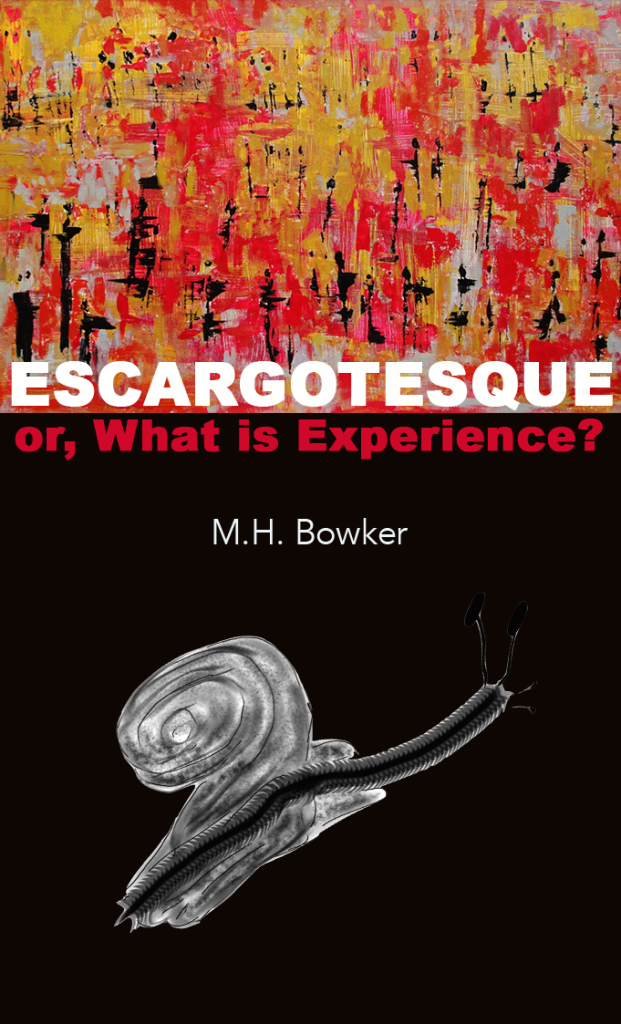
“In this unflinching, unconventional meditation on the understanding of self and identity, filtered through an ethical struggle with visitation and privilege, M.H. Bowker creates an odd, beautiful song of the self.”
— Chris Abani, author of The Secret History of Las Vegas and The Face: A Cartography of the Void
“Escargotesque, M.H. Bowker’s restive, memoir-driven meditation on experience, immerses the reader in a mood of sustained contemplative urgency, the peculiarly forceful pull of which inheres, I think, in the unnerving experience of gradually coming to appreciate, with the author, just what a maddening, grasp-slipping Ouroboros of a concept “experience” is — as, e.g., when he cites Freud citing Lichtenberg’s joke that “experience consists in experiencing what one does not wish to experience,” and we glimpse with him the koanic impossibility, the uncrackable kernel of encrypted (non-? anti-?) wisdom this remarkable book winds sinuous coil on coil around, in dexterously flexible prose (plus the occasionally interspersed pencil-sketch and snatch of verse) that when called on to do so adroitly tone-shifts from assured, Montaignian savoir faire to bursts of Kierkegaardian intensity.”
— Jonathan Callahan, author of The Consummation of Dirk, Winner of the Starcherone Prize for Innovative Fiction
Go to book page for more info., summary, and links
“Bowker rescues absurdity from literary and philosophical neglect, showing how it affects the work of diverse authors such as Dylan Thomas, Judith Butler, Giorgio Agamben, and Emmanuel Levinas, not to mention a television show about zombies. Absurdity, he argues, is a protest and defense against the meaningful experience of loss. Especially valuable is Bowker’s playing off the literature of absurdity with his own qualitative research on the topic. The book is a dazzling display of erudition by an intellectual who has his feet on the ground, a rare combination of virtues.”
— C. Fred Alford, Professor Emeritus, University of Maryland, College Park
“Matthew Bowker has written a welcome exploration and critique of the treatment of subjectivity in contemporary literature. Especially notable is Bowker’s treatment of grief and the insistence on the part of some authors that acceptance of loss is neither possible nor desirable. In developing his ideas, Bowker poses and suggests answers to a number of genuinely important questions including whether what he refers to as the “absurd experience” offers freedom from illusion or instead “a regressive and melancholy illusion about the value of perpetual grief whose goal is to incapacitate subjects so that all may share the same absurd fate.” This is an engaging book filled with sharp insights into matters of importance. It offers a much needed counterpoint to the celebration of suffering that is so much a part of our intellectual and political landscape.”
— David Levine, Professor Emeritus, University of Denver
“A valuable addition to the literature that contests the fashionable celebration of an absurd existence. This is an insightful and important work.”
— Stephen Eric Bronner, Board of Governors Professor of Political Science, Rutgers University
Go to book page for more info., summary, and links
“Bowker’s book examines Camus’ notion of the absurd in relation to the findings of modern psychoanalytic theory of ambivalence. His reading sets aside the ‘ontological’ questions most often associated with the absurd—the ‘human condition,’ ‘the silence of god,’ ‘the deprivation of transcendence,’ ‘metaphysical revolt’—in favor of an analysis that treats the experience as a ‘psychological disposition.’ By means of this approach, Bowker succeeds both in overcoming the fruitless logical and epistemological debates about Camus’ achievement that have dominated the literature for decades and in opening up a space in which the anthropological and experiential depth of Camus’ analysis might be regained. Paradoxically, he also restores the ontological realities he initially sets aside to their rightful place in Camus’ thought—‘more as overpowering love-object[s] than an unthinkable ‘is-ness’.’ A thoughtful and engaging book.”
— Ron Srigley, Laurentian University of Sudbury
“Matthew H. Bowker’s study, Albert Camus and the Political Philosophy of the Absurd: Ambivalence, Resistance, and Creativity, is arguably the most insightful, thoughtful, and well-researched book on Camus studies to appear in recent years. . . .Every once-in-a-great-while there comes a book that is so engaging, so thorough, and so enjoyable to read and comprehend that it becomes a classic and a necessity for all academics in that particular field to own, study, and know. Bowker’s Albert Camus and the Political Philosophy of the Absurd is that book. There is no doubt that it will indelibly shift and change the foci of Camus’s political thought in addition to offering a fantastic and clarified understanding of the Absurd. Without reservation, every serious scholar of Camus studies needs to have this book in his or her library. It is invaluable.”
— Peter Francev, Editor, Journal of Camus Studies
“Bowker’s approach . . . opens the way, he suggests, to advances in contemporary psychosocial understandings of moral and creative action and interaction. . . . This book is a cogent and thought-provoking reappraisal of Camus and key aspects of political philosophy.”
— French Studies
Go to book page for more info., summary, and links
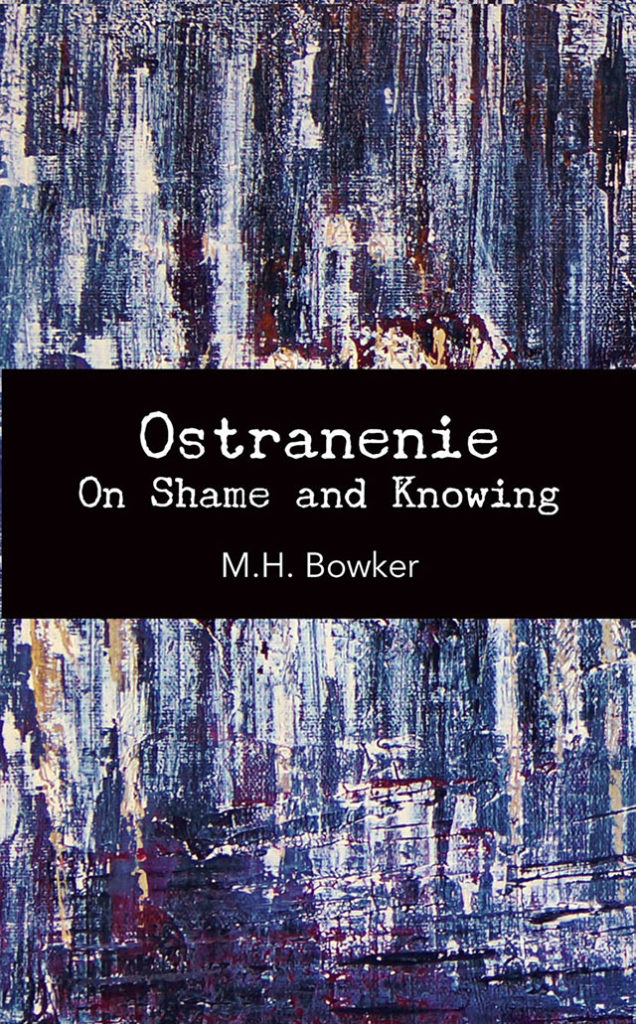
“While Ostranenie takes its title from an obscure Russian term for feelings of defamiliarization, and while its form foregrounds the cerebral, footnotes pushing poetic text off the page, and while its author is shamelessly intellectual, dropping, for instance, “Verfremdungseffekt” in the book’s first fifty words, and while we might thus expect coolness, austerity, or flippancy from such a set of particulars, quite the opposite is true: this is a deeply moving book about the experience of grief, about how our books do and don’t prepare us for it, about how our closest human connections are both alienating and familiar, how grief takes us out of ourselves and returns us to ourselves. Bowker comes through the books and thinkers and languages to a very human place, as if to say,why shouldn’t thinking also make us human? And, why is this a surprise? Required reading for grad school people from working class roots.”
— Ted Pelton, Chair, Dept. of English, Tennessee Tech University
“Mourning is a state that’s perpetuated because we understandon some deep level that we’re incapable of recapturing what has been lost. Bowker further seems to argue that one cannot take solace in consolation, that it is something lost in the act of attainment. A photograph, for example, might over time become just another object in the world, void of associations. To revitalize a memory of something that’s been lost is an exhausting struggle.One must be vigilant, keeping memories alive through the endless machinations of footnote-producing thought. Toward the end of the book, Bowker writes: “It is sometimes as if we longed to feel simultaneously alive and safe, but pursued this desire in performances of theology, philosophy, poetry.” To feel all there is to feel, to grasp all the details he can about his mother, requires that he perpetually begin the project of resuscitation anew: fill out the details,gather together the disparate constellations of thought and image and tactile memory, and breathe life into it. I wish there were more books like Ostranenie,which demand from me a critical engagement, my trusty dictionary by my side—, which has left me eager to read M. H. Bowker’s next offering.
— Andrew Powers, Prick of the Spindle: A Journal of the Literary Arts

